What Is a Preposition?
A preposition is a word that links a noun or pronoun to the rest of the sentence, usually showing place, direction, or time. The noun or pronoun that follows is called the preposition's object.
Notice the name: a pre-position is pre-positioned — it sits before its object. Here, under comes before the warm blanket and tells us exactly where the cat is.
Quick Test 🧪
Try the word in this frame: "The cat is ___ the box." If it fits — in, on, under, beside, near, behind — it's almost certainly a preposition!
Types of Prepositions
Prepositions are sorted by the kind of relationship they show:
Place — Where?
in, on, under, between, beside, near
Direction — Which way?
to, into, through, across, toward, around
Time — When?
before, after, during, until, since, at
Other relationships
of, for, with, about, like, without
Prepositional Phrases
A preposition almost never travels alone. Together with its object (and any describing words), it forms a prepositional phrase.
Start with the preposition
The relationship word kicks things off: under…
Add the object (and its describers)
A noun or pronoun finishes the phrase: under the old wooden bridge.
The whole phrase does one job
It can describe a noun (like an adjective) — "the book on the shelf" — or a verb (like an adverb) — "she sang in the morning."
Preposition or Adverb?
Some words — like up, down, in, out, over, around, past, inside — can be a preposition or an adverb. How do you tell them apart? Look for an object.
| Word | Preposition (has an object) | Adverb (stands alone) |
|---|---|---|
| up | She ran up the hill. | She stood up. |
| inside | We went inside the house. | We went inside. |
| past | He walked past the store. | A car drove past. |
| over | It flew over the fence. | The game is over. |
🔑 The key test
Ask: "___ what?" If there's a noun or pronoun that answers (an object), the word is a preposition. If nothing follows and it just describes the action, it's an adverb.
Preposition or Adverb?
In, On, At
These three tiny prepositions cause the most trouble — especially with time and place. Here's the pattern:
| Preposition | Used for | Examples |
|---|---|---|
| in | months, years, seasons | in July, in 2026, in summer |
| on | days and dates | on Monday, on July 4th |
| at | clock times | at noon, at 3:00 |
| Preposition | Used for | Examples |
|---|---|---|
| in | enclosed spaces | in the room, in the car |
| on | surfaces & transit lines | on the table, on the bus |
| at | specific points | at the door, at school |
💡 Zoom in to zoom in
A handy way to remember: in is the biggest/most enclosed, on is a surface or line, and at is the most exact single point.
Myth Buster: Ending With a Preposition
You may have heard a "rule" that you should never end a sentence with a preposition. Here's a secret: that's not really a grammar rule — it's an old style preference, and most writing experts today say it's perfectly fine.
sounds far more natural than "For what are you waiting?"
💡 Trust your ear
If rearranging a sentence to avoid ending with a preposition makes it sound stiff or strange, leave it alone. Clear and natural beats stuffy every time.
Where Is the Cat?
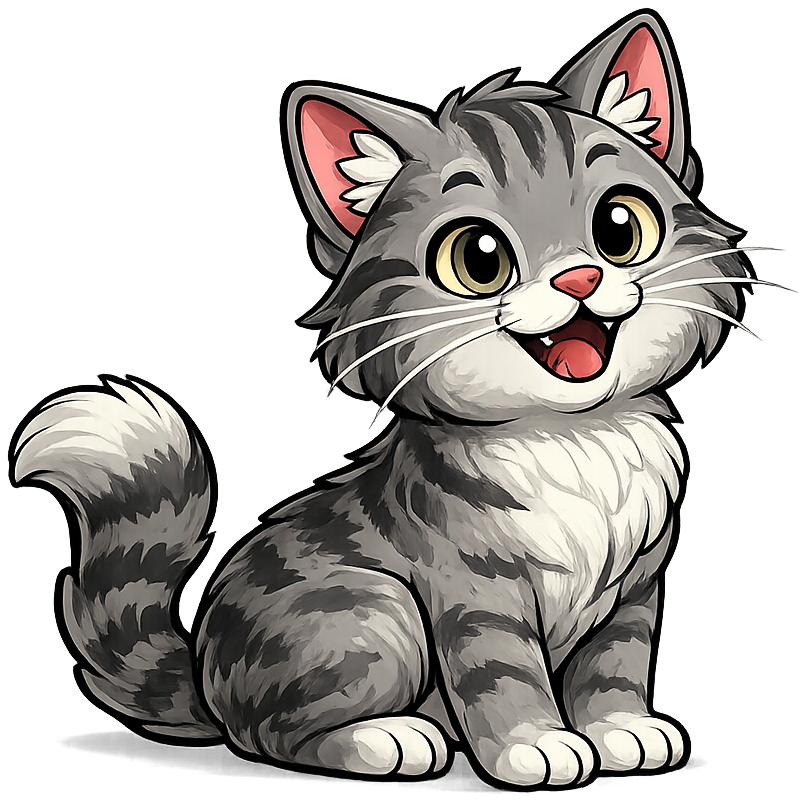
Look carefully at where the cat is compared to the box, then tap the preposition that describes its spot. The cat will move to a new place each round!
Find the Prepositions
Click or tap every preposition in each sentence — the relationship words that come before a noun. When you've found them all, check your answer!